





Your Travel Experience with Galapagos PRO
Day 1
Transfer to hotel
Day 1 - 4
Overnight stay at the Go Quito Hotel.
Day 2
Quito city tour: historic old town & equatorial monument
Today you will discover Quito. Back in 1978, UNESCO declared the old town of the Ecuadorian capital the first city to be declared a World Heritage Site. Quito has the largest contiguous colonial old town in South America. With its many sights, colonial townhouses, countless churches and monasteries, the influence of the Catholic Church is still unmistakable today. You start the tour in the heart of the colonial old town on the Plaza de la Independencia, also known as Plaza Grande. Here you can observe the hustle and bustle of the locals, visit the presidential palace and stroll through the many small alleyways. Continue to the Plaza San Francisco and the magnificent La Compañia church, whose construction was begun in 1605 by the Jesuit order. Afterwards, drive up to the so-called "Panecillo" for a panoramic view of the city. On a clear day, you can see four volcanoes from up here: Cotopaxi, Antisana, Cayambe and Pichincha. Later you will drive to the equator monument "Mitad del Mundo" - the "middle of the world" at latitude 0. Here you can stand with one foot on the northern hemisphere and the other on the southern hemisphere.
Day 3
Cotopaxi volcano - Hacienda Ciénega - market visit and rose plantation
Early in the morning, we drive about 80 kilometres south to Cotopaxi National Park. Cotopaxi, which erupted in August 2015, is one of the world’s highest active volcanoes. A beautiful hike leads to a viewpoint overlooking the volcano as it spews ash. When visibility is good, this is a magnificent experience. At lunchtime, we drive to Hacienda La Ciénega, which once captivated Alexander von Humboldt. To this day, the hacienda harbours the secrets of historical events and offers interested travellers lunch and a collection of wonderful stories. The hacienda’s gardens are an attraction in their own right and always worth exploring. Afterwards, we visit a beautiful rose plantation – one of Ecuador’s top export products. In the early evening, we’ll watch the sunset over the magnificent landscape before returning to Quito.
Day 4
Transfer to the Airport
Flight to Coca in the Amazon rainforest
Your journey begins with a 35-minute flight from Quito to Coca. On arrival at the airport, you will be met by staff from Sani Lodge. Your bilingual nature guide will give you safety instructions before you board a boat for a 2½-hour trip along Ecuador’s largest tributary of the Amazon. During the trip, you will get a taste of the Amazon’s flora and fauna. You will already be expected at Sani Lodge, where you will be welcomed with drinks.
Day 4 - 7
Overnight stay at Sani Lodge.
Day 1: Walk through the rainforest In the late afternoon, you’ll go for a short walk. Along the way, you’ll spot monkeys, birds and black caimans, and discover the amazing flora, including cedars, orchids, bromeliads and more. Back at the Sani Lodge, the head chef will be waiting to treat you to a wide selection of national and international dishes. In the evening, your nature guide will tell you all about the Amazon region.
Day 2: Morning: Observation tower overlooking the Amazon region After breakfast, you’ll take a canoe trip of about half an hour on Lake Challuacocha, followed by a short walk to the 36-metre-high observation tower. From the tower, you can spot over 565 species of birds, including macaws, toucans, flycatchers and hummingbirds, and, with a bit of luck, get a close-up view of monkeys or sloths. You will then return to Sani Lodge for lunch.
Afternoon: Guided walks through the rainforest In the afternoon, you’ll walk through the fabulous tropical rainforest and see orchids, lianas, fig trees, ancient trees and bromeliads. After dinner, you’ll go on a night walk with a nature guide to observe the various nocturnal animals of the jungle.
Day 3: Morning: Visit to Yasuni National Park After breakfast, you’ll travel along the Napo River to Yasuní National Park. There, you’ll visit the parrot clay lick. Here you’ll have a wonderful view of hundreds of parrots gathering around the mineral-rich clay. You’ll see yellow-crowned, orange-headed and blue-headed parrots. You will then travel south along the Napo River within Yasuní National Park and encounter some species not found in the north, such as: golden-mantled marmosets and spider monkeys, blue and yellow macaws, and, with a bit of luck, you may have a close encounter with white-lipped or collared peccaries, a species of peccary native to the American continent.
Afternoon: Local community and night walk At the Sani Community Centre, you’ll gain an insight into how a typical Kichwa family lives. Enjoy the food, drinks, customs and culture of the Sani community and learn how the locals’ way of life is ecologically sustainable. Return to the lodge in the late afternoon for a well-deserved dinner. After dinner, you’ll go on a night walk.
Day 4: Return journey to Quito Return transfer to Coca Airport After breakfast, you’ll have one last chance to watch the monkeys whilst taking a stroll along the riverbank before you set off again.
Please note that the order of activities may change whilst you’re there.
Day 7
Flight to Quito
Day 7 - 8
Overnight stay at the Go Quito Hotel.
Day 8
We are taken to Quito airport early in the morning.
Flight to the Galapagos-Islands
Day 8 - 15
Cruise on board the Tip Top II
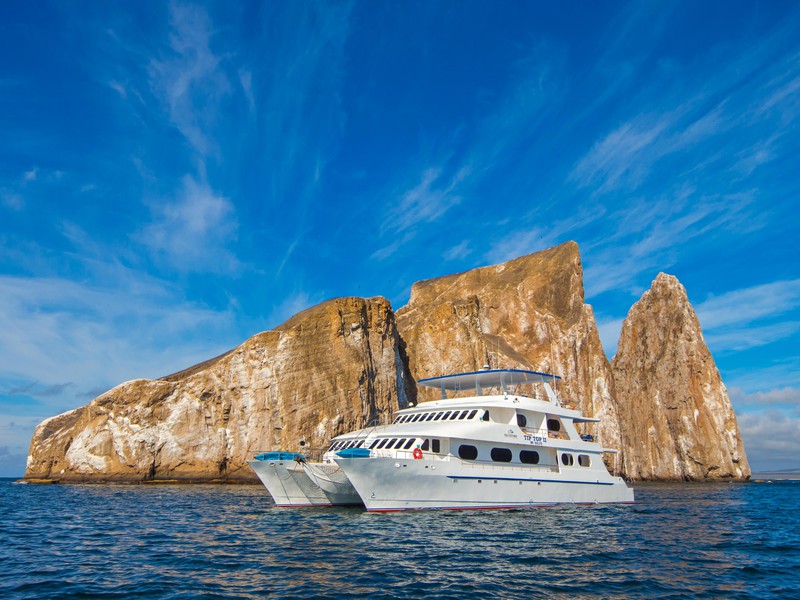
The first class motor catamaran Tip Top II was built in 2008 and refitted in 2015/2016. It belongs to the fleet of Rolf Wittmer's shipping company and has a capacity of 16 passengers with 4 deluxe double cabins on the main deck, 4 deluxe double cabins on the upper deck and two deluxe single cabins on the main deck. The upper deck cabins have a private balcony. All cabins are equipped with a safe, hairdryer and air conditioning. Guests can also expect a lounge, a spacious dining area, an outdoor bar and an inviting sun deck. With these many amenities and a beautifully designed expedition program, the Tip Top II offers an unforgettable Galapagos cruise.
Key features:
- Each cabin with private bathroom and air conditioning
- Bar
- Dining room
- Sun deck
Day 8
Arrival at Baltra Island
Upon arrival at Seymour Galapagos Airport (GPS), we will be met by our naturalist guide and taken to the port of Baltra Island, where we will embark.
Mosquera Island
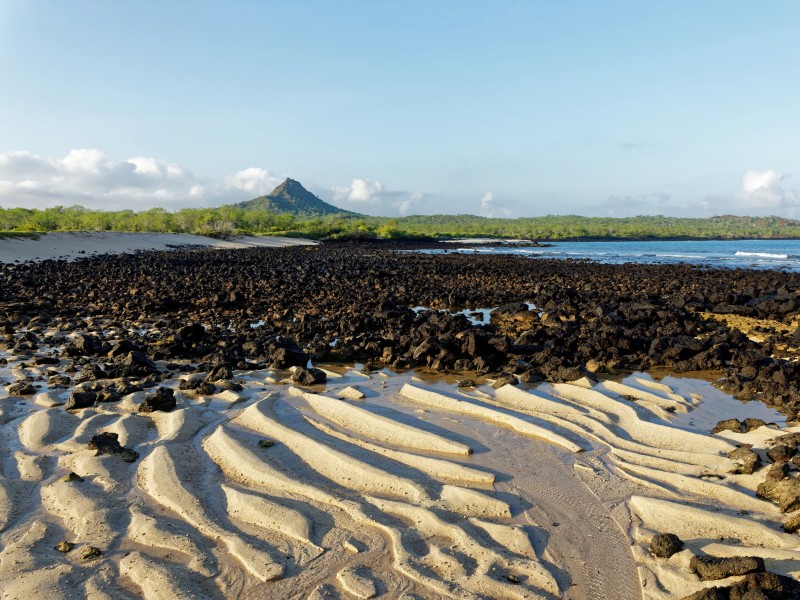
Afternoon: After lunch, we make a wet landing on the small island of Mosquera, which consists mainly of reef rocks and coral (the result of a tectonic sea uplift). It also has a large white sandy beach and several tidal pools where the local sea lion colony likes to bathe. Here we can observe brown pelicans, blue-footed boobies and cliff crabs in peace. The contrast between the bright red crabs and the pitch-black lava is a real eye-catcher. Optional: time for those who want to go swimming and snorkeling. In the evening we have an introduction to the Galapagos Islands in general, their formation and development. Afterwards we enjoy a welcome cocktail with the whole crew and later dinner.
Day 9
Sullivan Bay on Santiago Island
In the morning: After breakfast, we land at the bay "Bahía Sullivan". This is a perfect place to trace the volcanic origins of the islands. Optional: time for those who want to swim and/or snorkel. Afterwards we return on board for lunch.
Rábita Island
Afternoon: After lunch, you will make a wet landing on the dark red island of Rabida. Here you can observe marine iguanas and sea lions, pelicans, blue-footed boobies, masked boobies and brown pelicans. You take a short walk and reach a small saltwater lagoon where you can see pink flamingos foraging. Optional: time for those who want to swim, snorkel or kayak. Return to the boat for dinner.
Day 10
Punta Espinoza on Fernandina Island
In the morning: You land at "Punta Espinoza" (dry) and get to see a very large colony of sea lions, marine iguanas, cormorants and lava cacti. You will return on board for lunch.
Elizabeth bay on Isabela Island
Afternoon: In the afternoon, take a boat trip to the small bay of "Bahía Elizabeth" to see marine iguanas, penguins, turtles, seabirds and shorebirds, herons and blue-footed boobies. You return to the catamaran, have dinner and discuss the next day.
Day 11
Urbina Bay on Isabela Island
Morning: After breakfast, land at the bay "Bahía Urbina" to take a walk there and see an area known for corals, land iguanas, cormorants and giant tortoises. Optional: time for those who want to swim, snorkel and/or kayak.
Tagus Cove, Isabela Island
Afternoon: A little later, you will take a boat trip to the small bay "Tagus". This is a bay that lies between two volcanic craters and is therefore protected from the open sea. Here you can observe penguins, marine iguanas, sea lions and a large number of different bird species, such as the cormorant and blue-footed booby. Optional: time for those who wish to swim, snorkel and/or kayak. Return on board in the early evening.
Day 12
Puerto Egas, Santiago Island
In the morning: After breakfast, you will land at the bay "Bahía James" (Puerto Egas). There you will go on a hike and discover mussels, stone crabs, a large variety of coastal birds, barnacles, the endemic Galapagos blenny, marine iguanas, sea lions and much more. Optional: time for those who wish to swim, snorkel and/or kayak. Lunch on board.
Bartolomé Island
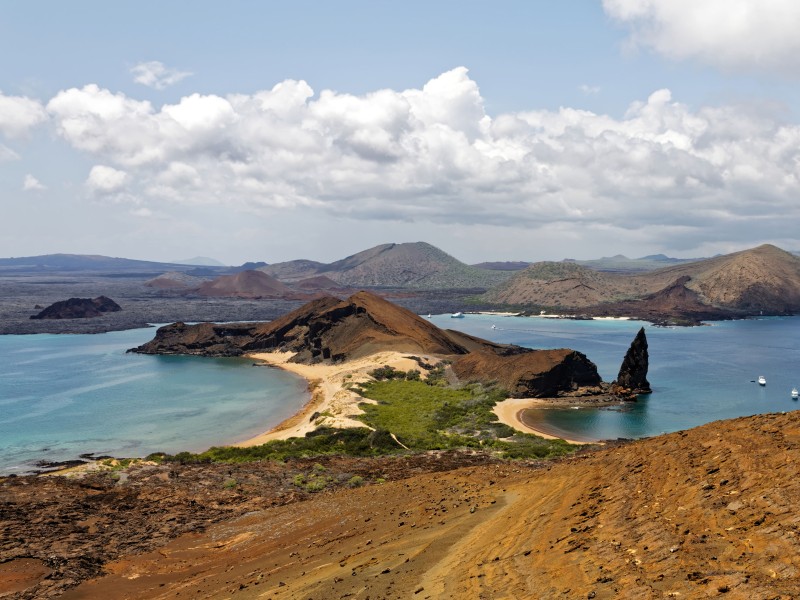
Afternoon: In the afternoon you land on Bartolomé Island to climb up to the summit. On the way you will see marine iguanas and small lava lizards. Once at the top, you will have a fabulous view over the surrounding islands and also of the eroded lava cone "Pinnacle Rock". It's back on board for a delicious dinner.
Day 13
Chinese Hat Island
In the morning: After breakfast, you will land on the island of Chinese Hat (Sombrero Chino), a small island off the coast of Santiago Island. The rocky coastline here is very interesting: Galapagos penguins, eagle rays, sea lions and marine iguanas have their home here. This is an excellent snorkeling spot and you can use the time to swim, snorkel or kayak. You return to the boat for lunch.
Dragon Hill bay on Santa Cruz Island
Afternoon: In the afternoon, you make a dry landing at Dragon Hill on Santa Cruz Island. The special feature here are the land iguanas. During a walk, you will pass a salt lagoon where there is plenty to discover: Flamingos, stilts, pintail ducks and many other bird species. Here, too, you will have time to go swimming or snorkeling. Dinner awaits you on board.
Day 14
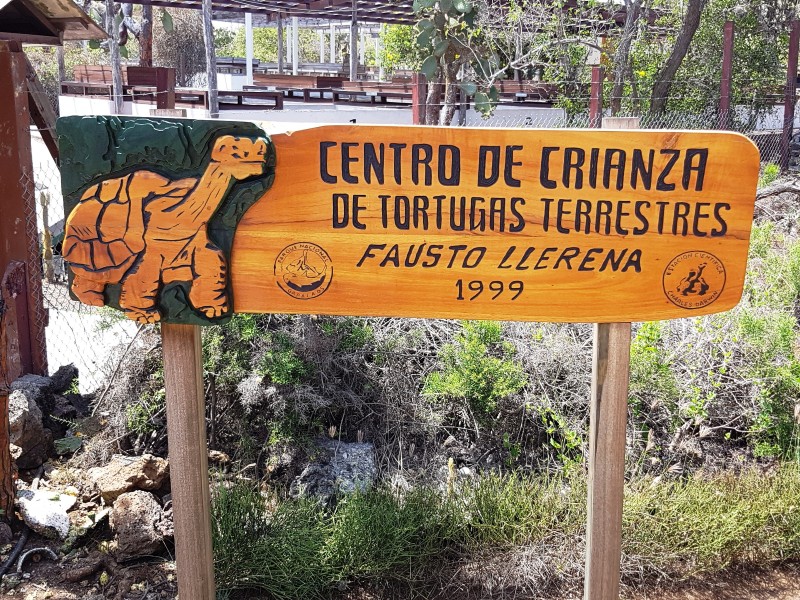
Highlands of Santa Cruz Island & Fausto Llerena breeding center
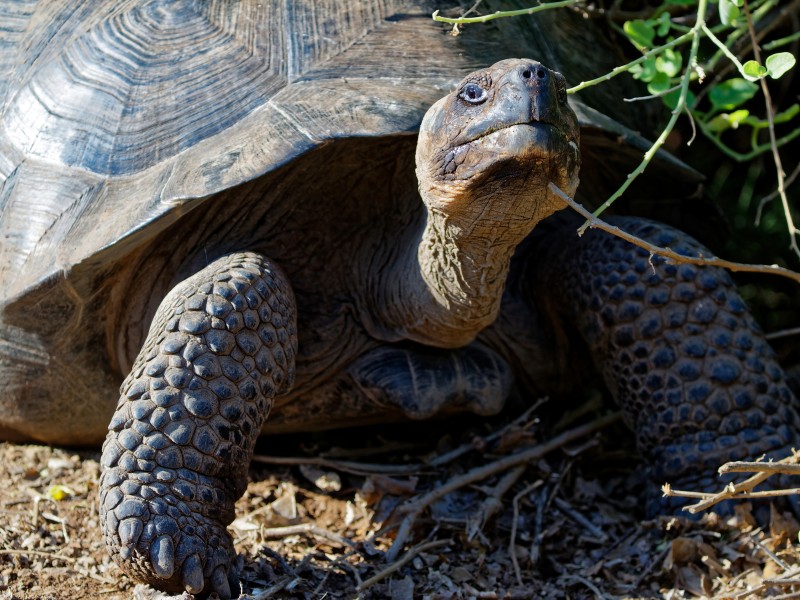
Morning: After breakfast, disembark and take the bus to the highlands of Santa Cruz to visit the indigenous forests. You will pass the imposing twin craters for a photo stop and then visit one of the farms where the giant tortoises can be observed in the wild. Enjoy your lunch at the farm today.
Afternoon: After lunch at the farm, head back to the coastal town of Puerto Ayora and visit the Fausto Llerena Interpretation Center, where you can learn all about the life of turtles on the islands. Then it's back on board the catamaran for dinner.
Day 15
North Seymour Island
Morning: After breakfast, depart for an early dry landing on North Seymour Island. You walk along the coast and into the interior of the island, a very flat island that has been lifted out of the sea by underground seismic activity. Here you can see blue-footed boobies (nesting season from May to November), marine iguanas, pelicans, frigate birds, shorebirds, sea lions and the endemic Palo Santo tree. You return to the boat.
Departure from Batra Island
You reach the port of Baltra. From there, you drive to the airport and board your return flight to Guayaquil.
Flight to Guayaquil